
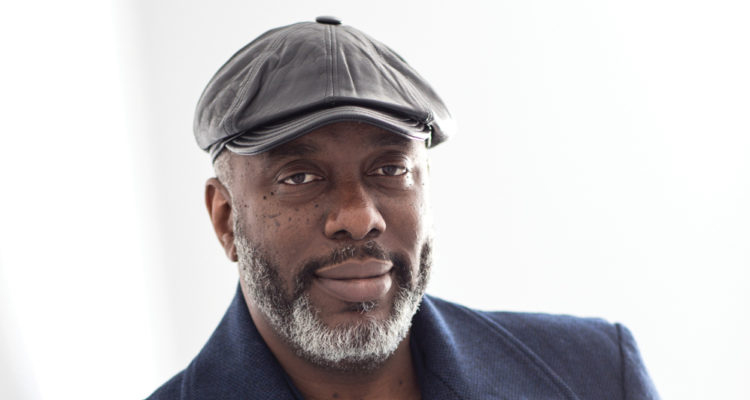
Thabiti Anyabwile is one of the most thought-provoking, genuine and ecumenical brothers I’ve had the pleasure of meeting. I’ve benefited greatly from his books, as well as his voluminous Pure Church blog, hosted by The Gospel Coalition.
I figured I might benefit from asking him a few questions and digging a little deeper, and I think you will, too. So, without further delay, here is what I believe to be an amazing interview with the man himself.
Before we start talking about you, let me ask about this new thing you’re part of. What can you tell me about TheFrontPorch.org?
The Front Porch is a website dedicated to “conversations about biblical faithfulness in the African American church and beyond.” It’s a partnership with fellow pastors Louis Love and Tony Carter to broker discussions with a range of voices on the Black church, its history, practices and mission.
Wow. That seems like something we should be spreading the word about. Switching gears: You’ve written a ton of high-quality blog material, and in this day and age, that’s really saying something. Get it?
I know one of your most popular posts was “I’m a Complementarian, But …” Why did you write that post, and why do you think it was so popular?
I wrote the posts because I’m concerned that a lot of complementarian practice exceeds biblical warrant. I’m concerned that some freedoms Christ gives our sisters can be restricted out of a hyper-concern for biblical gender roles.
In other words, we can too easily get the balance wrong. I think the complementarian vision is biblical and beautiful, but it needs to be protected from both those who oppose it and those who pursue it poorly.
I think the posts struck a chord because a lot of our sisters have been feeling wrongly restricted. They’re complementarians. They’re not seeking to rewrite biblical roles or oppose godly authority. But when they raise questions about practice, they’re often treated as if they are the enemy.
I think some of those women appreciated a male voice stating what they had been trying to say for a long time.
I also think there are a good number of complementarian men who chafe at what feels like a 1950s-style caricature of biblical gender roles. They feel pressed into one way of being a “biblical man,” and they want room to apply the teaching of Scripture in a way that’s faithful both to the text and to the way the Lord has shaped them.
You seem to be a big fan of spoken word and Christian hip-hop. Why do you think these mediums have been so influential in the evangelical church lately? Is it just a fad, or will these art forms continue to fruitfully serve the bride of Christ?
We’ll see whether spoken word and hip-hop are just fads in the evangelical world. There used to be a lot of people who said hip-hop itself was a passing fad and would fade away.
But it has grown up to become arguably the most dominant cultural form in the world, spawning everything from music and clothing lines to fragrances and movies. The cultural aesthetics of hip-hop can hardly be resisted, whether you’re in Tokyo or Topeka. It’s that powerful.
Personally, I think Christian hip-hop is here to stay. As long as spoken word remains tethered to hip-hop in some way, I think it has staying power, too.
I think these mediums have become so influential because the Christian hip-hop generation is coming of age. The hip-hop generation has finally reconciled the art form with the faith. That was much more difficult 10 or 20 years ago. It’s not a question now, and consequently, that generation is coming out in significant numbers.
Then there’s the undeniable lyrical power of the mediums. It takes me 50 minutes to say in a sermon what these artists can communicate in five minutes, and they can do it far more powerfully.
That’s another explanation for their reach. Even cats who can’t bob with the music love the truth they hear. It’s simply powerful.
The challenge going forward will be whether it continues to become part of the church or sets itself apart from the church. I’d hate to see another level of Christian segregation develop along these lines. The church is divided enough. We have to find a Romans 14-15 way of accepting one another.
True enough. Speaking of accepting one another, a young man on Twitter recently said, rightly or wrongly, that minorities have more to offer than opinions about race and that white people need to seek out minority expertise in other areas, such as systematic theology.
A comment like that may be difficult for some white people because they often hear minorities saying, “You don’t understand, you don’t listen and you don’t ask to hear directly from us on race issues.” So, in light of those sentiments, white people try to do just that and ask minorities for their thoughts on race. Then they receive the feedback, “We have other stuff to say, too, you know.”
How are we supposed to navigate this? Is each side right? Is each side wrong? Are we simply talking past one another?
Man, I don’t have great answers on this dynamic. Conversations about race are so fraught with peril that they have unexpected and unpredictable consequences for other conversations.
Sometimes a good experience opens doors and builds credibility on other subjects. But sometimes a good experience pigeonholes you with some people. Bad experiences can shut down all conversations, or they can make you avoid conversations about race altogether.
I don’t think this phenomenon is linear. It’s all over the map, largely because race itself is an irrational and fictional construct. But that’s another interview.
I think the best we can do is commit to something that requires us to remain in all kinds of conversations and exchanges. That is Christian brotherhood and friendship.
If I’m committed to you as a brother, sister and friend, then I’m actually interested in what you think about almost everything. I don’t limit our brotherhood to race or to one theological topic.
Our friendship takes us naturally to a host of issues as they arise, usually without fear and trepidation. The most significant hindrance might be that we aren’t yet committed to one another as people, as brothers and sisters in Christ and as friends.
So, we keep trying to have piecemeal conversations that never feel safe or natural.
Trillia Newbell’s new book, United, places a wonderful emphasis on the power of friendship for having some of these discussions. I’d highly recommend it.
You might also check out Christena Cleveland’s new book, Disunity in Christ, for a very readable social-psychological treatment of this issue. I highly commend that book, too.
Also, ethnic minority groups in the U.S. simply have to do theology and produce solid theological work where they are without worrying about white consumption.
I know there’s an important conversation to be had about inclusion at the academic and popular levels. That’s a real conversation.
But sometimes I think we are far too concerned about what our white brothers and sisters think of us rather than getting on with the work and, if necessary, creating our own channels of distribution.
It has never been easier to publish than it is right now. You can start an imprint and self-publish online with minimal costs. Creating a web presence or hosting a conference is easy if there’s the will.
So, it’s likely that we simply need to produce more and broker our own conversations so the theological movements in diverse communities can mature without depending on acceptance in white circles.
Our white brothers can join us on those terms if they like. But we don’t always have to seek inclusion and approval from them.
Where we are seeking that approval, we need to ask ourselves some hard questions, such as, “Why do I want or need it?” and, “To what purpose am I putting this to use?”
Responding to the tweet mentioned in the previous question, someone said, “I would love to read more biblical and systematic theology from Black authors. Can you point me to some?”
I’m not sure whether the person who made that comment was trying to make a point, but there is obviously much less theological literature being produced by minorities. Why is that, and are we on the path toward changing it?
The reason there’s less in evangelical and Reformed circles is that there has historically been less opportunity.
Keep in mind that African American participation in conservative theological institutions is pretty recent, dating to the 1970s in most cases. Participation in liberal institutions occurred earlier, but even then, the roadblocks to academic posts in theology were tremendous.
So, the legacy of Jim Crow still lives in this disproportionate situation.
At the same time, African Americans have continued to give first place to the local church. Even when many pursued advanced studies, they did so with an eye toward the pastorate, not the academy.
There are many reasons for that, but the most basic is that African Americans still hold the church and pastors in high regard. So, practical theology programs and teaching posts attract a disproportionate number of African Americans. I’m not sure how that tracks with other ethnic groups.
But I do think we’re seeing significant change on this front.
On the left, academic theology has long received emphasis and financial support. The Seabury Consultation created a pipeline of African American Ph.D.s that reads like a who’s who among theologically progressive and liberal theologians.
The conservative side has lagged, but some efforts are underway. Reformed Theological Seminary has its African American Leadership Initiative program, which offers some financial support.
We need more efforts like that. But individuals are pursuing advanced degrees and producing solid work.
I think of Jarvis Williams at Southern, Vincent Bacote at Wheaton, Anthony Bradley at King’s and a host of others. The game is changing, even if slowly.
You’ve recently announced your move to Washington, D.C., to plant a church. Why leave the glory of the Cayman Islands? Why D.C.?
The simple answer is a sense of calling. Not just my individual, subjective sense, but also confirmation from my elders in Grand Cayman and from a number of trusted advisers.
Going to Cayman was never about the glory of the beaches and the like. It was always because the Lord gave me a love for the people of First Baptist Church, whom I still love.
But over the last two years, He has given me an increasing burden to see what we hope will become another solid work in Washington, D.C.
Why D.C.? The city became home for us when we moved there in 2000. The Lord saved me in D.C. in 1997.
Southeast D.C., or East of the River, where we hope to plant, was our introduction to the city when we first began visiting in the late 1980s.
That was a different time. The crack epidemic was in full swing, and D.C. was considered one of the murder capitals of the country.
Much of the city has changed since then. But East of the River has trailed that change, and we want to be part of the good-news story happening there.
We’re betting on the Gospel. We want to see it take root in neighborhoods like Anacostia all over the country.
Of the several books you’ve written or contributed to, which one holds a special place in your heart, and why?
The Decline of African American Theology is the dearest to me of the books I’ve written.
But that book was difficult to write, both emotionally and intellectually. It required a lot of work with original source material, and it told a story that needed to be told but hadn’t been.
It has certainly been the most controversial, but usually among people who haven’t read it, haven’t read it on its own terms as a historical theology rather than a social history of the church, or who feel protective of the Black church for various reasons.
But I think the book continues to fill a void in the literature on the church, even if it’s a difficult story to take.
It was written with the kind of love that risks telling a difficult truth about the one being loved.
As for books I’ve contributed to, I think it would be Tony Carter’s edited volume, Glory Road. Those 10 testimonies are simply encouraging to read.
Your favorite theologian, and why. Go.
My mama. She raised me.
Your wife is trying to make you eat healthier. Is it hard being married to someone who hates you and wants you to be miserable?
Ha ha. Naw, she loves me and is trying to keep me alive.
I appreciate it, even though I joke her relentlessly on Twitter. Mainly, she just tries to sneak green stuff into my food.
But she has a sweet tooth, so we hit the cheesecake from time to time. 😉