
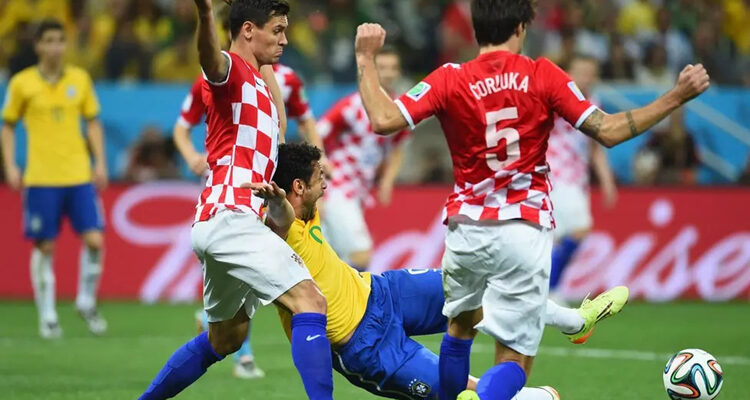
In light of the World Cup and the recent completion of the NBA Finals, the flopping epidemic needs to be addressed. Many people have weighed in on the subject, both seriously and in jest, but the fact remains: Flopping is cheating.
In nearly every sport, particularly soccer and basketball, deception is a key part of the strategy employed by coaches and players. A coach may hide a play or disguise a defense to gain an advantage. Likewise, a player may fake one way to put a defender off balance before moving in another direction.
Those forms of deception create an advantage, but not an unfair one. They do not stop play or manufacture a penalty against an opponent.
Flopping, by definition, or at least by Wikipedia’s definition, mind you, “is an intentional fall by a player after little or no physical contact by an opposing player in order to draw a personal foul call by an official against the opponent.”
To reiterate, flopping stops play and causes an official to call a foul after a player intentionally deceives him. This form of deception is cheating because it creates an unfair advantage.
When Flopping Changes a Game
This may seem like a small issue, but it can have major consequences. Anyone who watched Brazil’s opening World Cup match against Croatia saw a controversial penalty called after Fred went down in the box following minimal contact.
The resulting penalty kick put Brazil ahead 2-1 and shifted the momentum of a match it eventually won 3-1.
Similarly, flopping has repeatedly affected the flow and integrity of NBA games throughout the regular season and playoffs.
So who is at fault: the officials or the players?
Players Bear the Greater Responsibility
Referees often receive the blame because fans expect them to correctly judge each play. However, professional sports move at extraordinary speed. No official can see everything perfectly from every angle.
Therefore, the greater responsibility rests with the players. They must decide whether to fairly exploit an opening or manufacture an unfair advantage that compromises the competition.
Professional sports organizations have attempted to discourage flopping through fines and other penalties for especially blatant violations. That kind of accountability is a step in the right direction.
Ultimately, however, flopping is a symptom of a larger disease. Our society often embraces a win-at-all-costs mentality that pressures coaches and athletes to do whatever they can to gain an advantage.
That pressure does not excuse the individual athlete. Instead, it makes personal integrity and character even more important when a player feels tempted to cheat.
The Problem Eventually Reaches the Kids
The deepest consequence becomes clear from the sideline of a youth soccer or basketball game.
The kid with the newest shoes and coolest arm sleeve begins substituting shenanigans for skill and flopping for fundamentals.
Sports are beautiful, and countless benefits come through participation at every level. But when seemingly small acts of cheating become acceptable and athletes repeatedly imitate them, those benefits begin to disappear beneath a destructive will to win.
As Scripture says, “A little yeast works through the whole batch of dough” (Galatians 5:9).
Flopping needs to stop for the sake of the players, officials, fans and the games themselves.
And, yes, for the sake of the kids.
Think about the kids.