

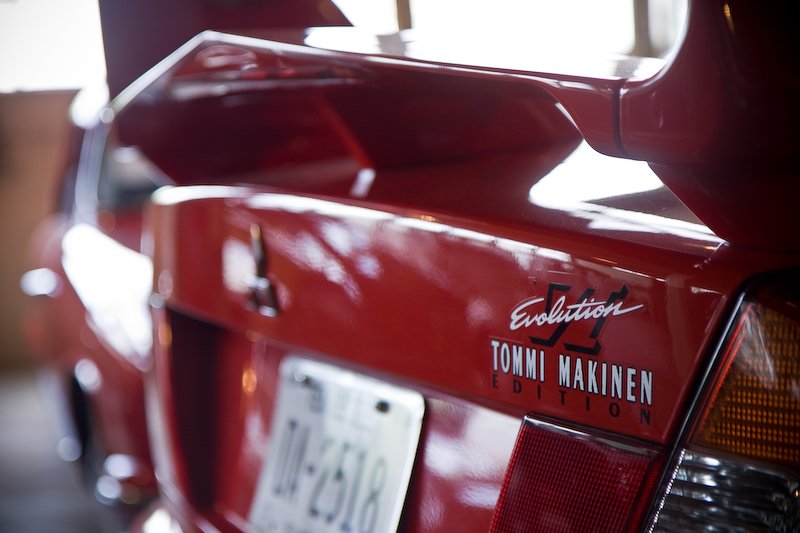
I found the Mitsubishi Evo VI in the basement of Lane Motor Museum in Nashville, Tennessee. A friend had signed us up for a tour, and we were walking past cars in various stages of repair when I turned a corner and saw one of the greatest Evo treasures imaginable: a 2001 Mitsubishi Lancer Evolution VI GSR Tommi Mäkinen Edition.
I’d been to the museum several times and always found something I’d missed. There are vintage race cars, microcars, amphibious vehicles and a military LARC-LX that looks capable of flattening houses at will. Even in that company, the Evo stopped me.
Some time after the tour, I called museum director Jeff Lane, told him a little about EvolutionM and asked if I could photograph the car. Fortunately, Lane is a car guy. He let me do considerably more than that.
Let the games begin.
Meeting the Evo VI Tommi Mäkinen Edition
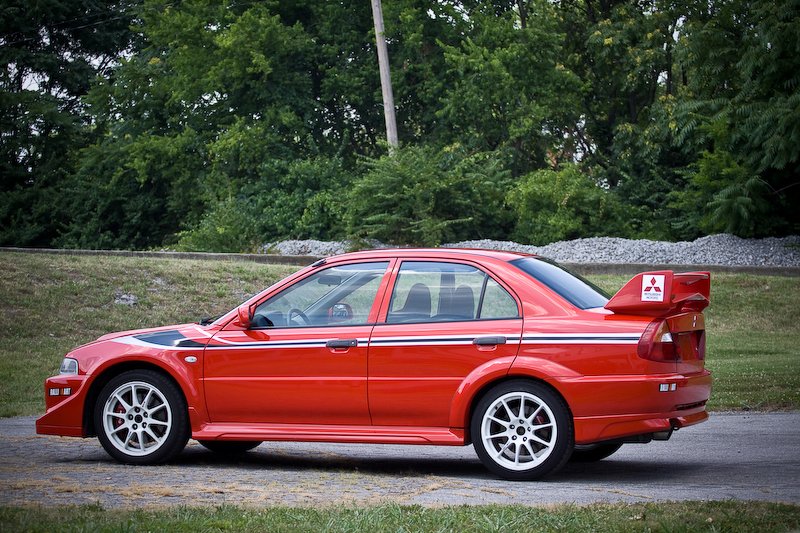
We met on a Friday afternoon, and the car was parked outside the museum. I’d never seen an Evo VI in person. The red paint and decals call to mind Mäkinen’s Marlboro and Ralliart rally livery. The front bumper is asymmetrical to make room for a functional cooling inlet. The body contours are sharp, the wheel arches have just the right amount of depth, and every element makes sense to me.
Open the door and the Evo X suddenly looks like a luxury car. There’s a Momo steering wheel and red seat inserts stitched with “T. Mäkinen,” but there isn’t even a radio. The seats remind me of the Evo VIII’s, with the fore-and-aft adjustment on the side. The dashboard and gauges are plain. It’s an economy car turned into an all-wheel-drive rally terror.
Driving the Mitsubishi Evo VI
Turn the key and it’s downright loud for a stock car. Imagine an Evo VIII with a cat-back exhaust and you’ll be close. Lane has a short loop around the museum with tight city streets, a sharp on-ramp and a brief run down the interstate. After an exciting lap with him behind the wheel, he handed me the keys.
I leaned on it a little. I couldn’t bring myself to flog a literal museum piece, but it didn’t take long to get the idea. At idle, the factory motor mounts send vibrations through the steering wheel. The suspension makes our stock Evos feel like easy chairs. We hit a pothole and the impact traveled up my spine, rattled my brain and threatened to remove my fillings.
I was in love.
The first thing I noticed in the corners was how little effort the car took to change direction. Turn-in is crisp, and the early active yaw control system helps the car hold its line when it wants to push wide. Like every Evo, it’s a point-and-shoot car. This one shoots with less effort and less drama than its heavier offspring.
The special-edition turbo spools quickly, and the engine pulls cleanly to the rev limiter, which Lane was happy to demonstrate. I also loved the five-speed. In my experience, newer Evo gearboxes tend to feel notchier and more temperamental. This is easily the best Mitsubishi shifter I’ve used. The red Brembo calipers peeking through the wheels, on the other hand, feel familiar.

Weighing the Evo VI, IX and X
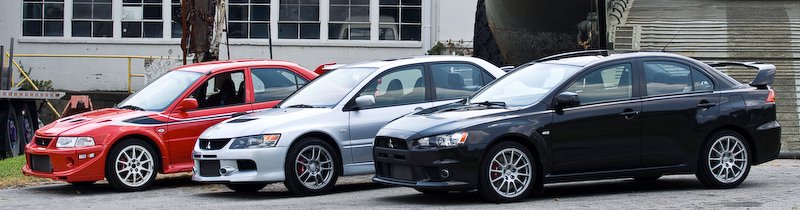
I was tired of finding different weights online, so we put three Evos on individual wheel scales. Alongside Lane’s stock Evo VI, we brought my friend Eric’s Evo IX and my Evo X. We also photographed all three next to the museum’s enormous LARC-LX.
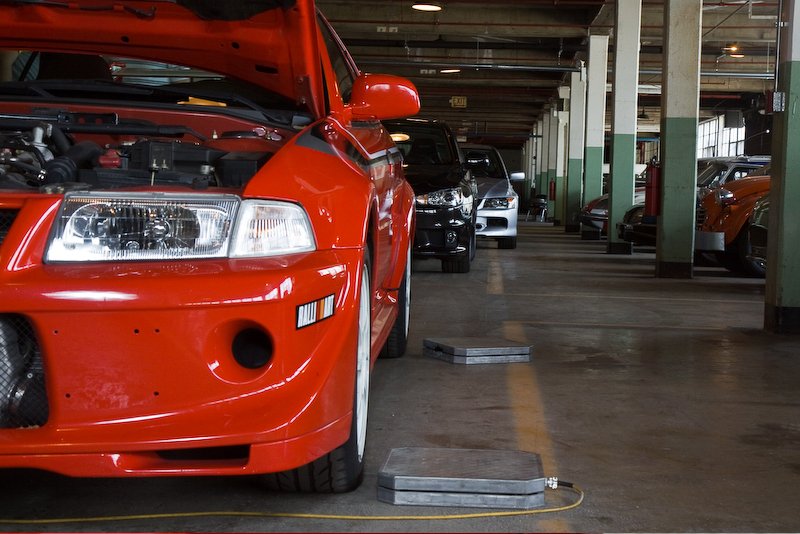

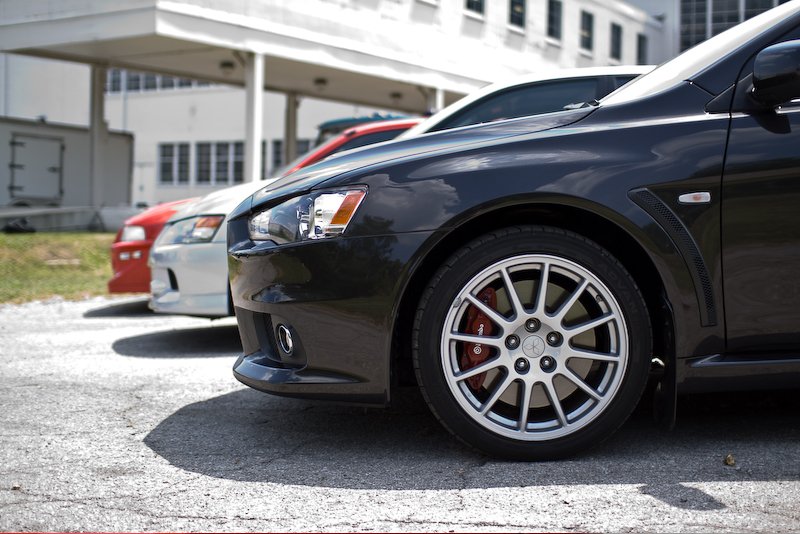
The Evo VI came in at 3,041 pounds, 311 pounds lighter than the IX and 469 pounds lighter than the X. Those are the weights of these three cars as tested. The cars carried different amounts of fuel, and my Evo X had its spare removed and a child seat installed.

Evo VI GSR Tommi Mäkinen Edition (CP9A)
- As-tested weight: 3,041 pounds.
- Weight distribution: 60% front, 40% rear.
- Corner weights: 895 pounds front left, 944 front right, 614 rear left and 588 rear right.
- Factory output: 276 horsepower at 6,500 rpm and approximately 275 pound-feet of torque at 2,750 rpm.
- Test configuration: Stock, with about a quarter tank of fuel.
We couldn’t put the museum car on the dyno. From the way it pulled, my guess is that it would make around 240 horsepower at the wheels on our Dyno Dynamics machine. On the road, the light weight and quick turn-in made a stronger impression than any horsepower figure. The trade-off is that you feel just about everything the road has to offer.
Evo IX SSL (CT9A)
- As-tested weight: 3,352 pounds.
- Weight distribution: 60% front, 40% rear.
- Corner weights: 1,026 pounds front left, 981 front right, 649 rear left and 696 rear right.
- Measured output: 267 horsepower and 266 pound-feet of torque at the wheels.
- Estimated engine output: Approximately 340 horsepower at 6,000 rpm and 340 pound-feet of torque at 4,200 rpm.
- Test configuration: Dyno4mance ECUFlash tune, with about two gallons used from a full tank.
The SSL package makes the IX a little nicer to live with. It has my favorite version of the 4G63 engine and, to my eye, the best exterior of any Evo. The U.S.-market car didn’t get Super Active Yaw Control. Of these three, the IX makes the best case as a daily driver.
Evo X GSR SSS (CZ4A)
- As-tested weight: 3,510 pounds.
- Weight distribution: 57% front, 43% rear.
- Corner weights: 1,024 pounds front left, 989 front right, 735 rear left and 762 rear right.
- Measured output: 309 horsepower and 308 pound-feet of torque at the wheels.
- Estimated engine output: Approximately 385 horsepower at 6,200 rpm and 385 pound-feet of torque at 4,600 rpm.
- Test configuration: Ultimate Racing turbo-back exhaust, upper intercooler pipe and Dyno4mance ECUFlash tune. Three-quarters of a tank, spare tire removed and Recaro child seat installed.
The Evo X’s all-wheel-drive system makes the car feel planted, and it can still rotate when you ask it to. The factory seats, audio and headlights are excellent. Some of what makes the X easier to live with also makes it heavier. The short gearing keeps it busy on the highway, and the transmission is notchy. It’s still an Evo at heart.
Which Evo Would I Take Home?
One of the liveliest threads I’ve had to moderate on EvolutionM pits the Evo X against the VIII and IX. Weight is one of the biggest complaints about the X. After driving the VI, I suspect its owners had much the same reaction when the Evo VII arrived.
For context, a stock 2003 Evo VIII makes about 205 horsepower at the wheels on our Dyno Dynamics machine. Stock IX and X models tend to make about 215 to 220 on the same dyno. The graph below shows Eric’s tuned IX and my modified X. Eric has ordered more Ultimate Racing parts and expects to gain power with another tune, though he plans to keep the factory cat-back exhaust to keep the car quiet.

As the cars sit, I think my X is the fastest of the three, followed by the VI. Lane’s favorite was the IX.
“That car is awesome, but it is a racecar,” he said, pointing toward the Evo VI. “It will beat you to death on the street.”
Then he pointed to the IX.
“This is the one I would drive every day,” he said. “It’s comfortable, has a nice leather interior and isn’t too loud.”
I differ.
I’ve owned many Evos and loved them all. I’d probably be happiest with one of each. But if I could choose only one, I’d take the Evo VI Tommi Mäkinen Edition.