
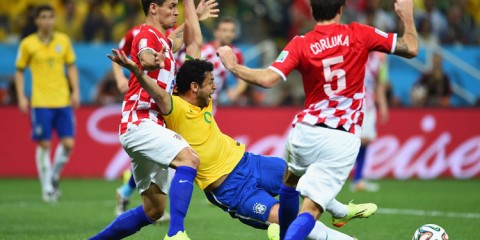
In light of the World Cup and the recent completion of the NBA finals, the flopping epidemic needs to be addressed. Many people have weighed in on this subject, both seriously and in jest, but the fact of the matter is that flopping is cheating.
In nearly every sport, and more specifically in soccer and basketball, deception is a key part of the strategy of every coach and player. From a coaches perspective, one must ‘hide’ a certain play, or ‘disguise’ a particular defense in order gain an advantage. As a player, it is beneficial to ‘fake’ one way in order to put your defender off balance and then proceed in a different direction. While these forms of deception are employed to create an advantage, they do not give an UNFAIR advantage, as they do not create a stoppage in play, nor do they result in a penalty of some sort.
Flopping by definition (wiki definition mind you), “is an intentional fall by a player after little or no physical contact by an opposing player in order to draw a personal foul call by an official against the opponent.” To reiterate, the result of flopping is a stoppage of play and a personal foul is called due to the referee/official being deceived by the ‘flopper’. This form of deception is cheating since it DOES create an UNFAIR advantage.
As this may seem like a small issue, it actually can turn out to have major implications. For anyone who watched the first World Cup match of Brazil vs. Croatia, there was a penalty called in the box – due to a flop – resulting in a penalty kick and goal which undoubtedly shifted the momentum and possibly altered the result of the match. Similarly, in the NBA play-offs (and throughout the entire season) there were multiple cases where flopping ended up having a deep impact on the flow and overall integrity of the games.
Now, who is at fault? The referee or the players? Many times the referee is placed with the blame as he/she is relied upon to correctly discern these type of plays. However, at the speed at which professional sports are played, it can be argued that there is no way for a referee to correctly see everything at all times. Therefore, the responsibility lands solely on the shoulders of the players. Players must decide weather or not to fairly or unfairly take advantage of a particular angle or situation and thus challenge the integrity of the contest through their actions.
It is commendable that some of the professional sports governing bodies have made an effort to curb the rampant flopping by enforcing fines and suspensions for blatant flops. That type of accountability is a step in the right direction.
In the end, flopping is only a symptom to an overall larger disease. Our society unashamedly endorses a ‘win at all cost’ mentality which produces an enormous amount of pressure for coaches and athletes to do whatever it takes to gain an advantage for their team and their fans. This is not to cop-out and place the blame on society, but rather to call out the individual integrity and character of athletes who are tempted to cheat in this particular manner.
The deepest consequence comes to light when you find yourself on the sideline of a youth soccer or basketball game and watch as the kid with the newest shoes and the coolest arm-sleeve begins to substitute shenanigans for skill and flopping for fundamentals. Sports are beautiful and there are countless positives that come through all levels of participation. However, when the “smallest” forms of cheating become acceptable and reproduced, it is only a matter of time until the benefits are choked out by a devilish “will to win”.
As the Word says, “A little yeast works through the whole batch of dough.” (Galatians 5:9)
Flopping needs to stop for the sake of the players, officials, fans, the game…and even for the sake of the kids. Think about the kids! (Really, there is no other way to close this discussion)